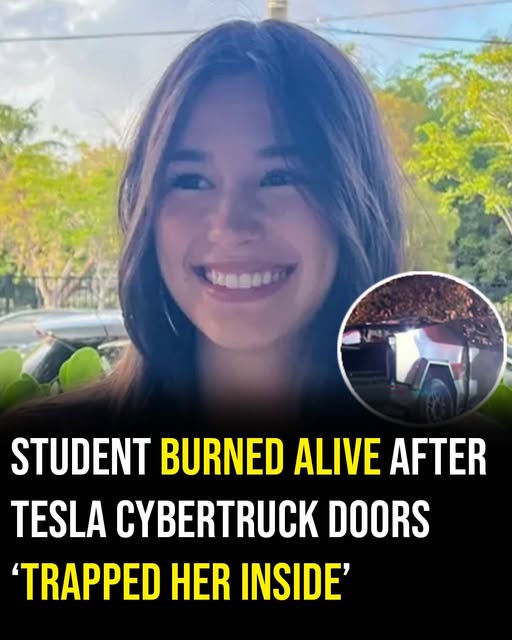
A tragic crash in California claimed the lives of three young people and left another seriously injured after a Tesla Cybertruck caught fire, trapping those inside.
On November 27, 2024, 19-year-old Krysta Tsukahara was traveling with three friends in a Tesla Cybertruck when the vehicle crashed into a retaining wall and burst into flames. According to a statement from the Piedmont Police Department, officers arrived to find the vehicle fully engulfed, resulting in multiple fatalities.
Tsukahara, along with driver Soren Dixon, 19, and passenger Jack Nelson, 20, were recent graduates of Piedmont High School who had returned home for Thanksgiving break. All three were unable to escape as the fire rapidly spread through the vehicle.
The only survivor, Jordan Miller, was rescued by a friend who had been driving behind them. Using a tree branch, the rescuer struck a window repeatedly until it broke, managing to pull Miller—who was barely conscious—out of the vehicle just before the flames intensified.
Reports later revealed that Dixon had methamphetamine and cocaine in his system, along with a blood alcohol level significantly above the legal limit. Toxicology findings also showed that Tsukahara and Nelson had alcohol and cocaine in their systems.
Although Tsukahara initially survived the crash with minor injuries, a lawsuit filed by her family claims she was unable to escape due to a failure in the vehicle’s electronic door system. According to the filing, both she and a bystander attempting to help were unable to open the doors. As the fire grew, she was ultimately overcome by smoke and heat.
Her family alleges that the vehicle’s design prevented escape, arguing that the electronic door system failed after the crash and that the manual release mechanism was too difficult to locate or operate in an emergency.
Lawsuits filed by the families of Tsukahara and Nelson accuse Tesla—led by Elon Musk—of neglecting known safety issues. They claim the company was aware of potential risks associated with its door systems but did not take adequate steps to address them.
The filings state that once the Cybertruck’s electrical system failed, the doors became unusable, leaving occupants trapped. While a manual override exists, the lawsuits argue it is not easily accessible in high-stress situations like a fire.
Family members described Tsukahara as a talented and compassionate young woman with a promising future. They also questioned how a company of Tesla’s scale could release a vehicle with alleged safety shortcomings.
Nelson’s family echoed similar concerns, stating that rear passengers had limited access to emergency exits, with release mechanisms that were difficult to find or operate amid smoke and panic.
Both families are seeking damages, alleging that the company knowingly sold a vehicle with dangerous design flaws.
Authorities have said that speeding and impaired driving were contributing factors in the crash. However, the families argue that these factors do not excuse what they describe as preventable design failures.
Since its high-profile launch in late 2023, the Tesla Cybertruck has drawn significant attention but also criticism, including recalls and legal challenges. As investigations continue, questions remain about vehicle safety and whether more safeguards are needed to protect passengers in extreme situations.