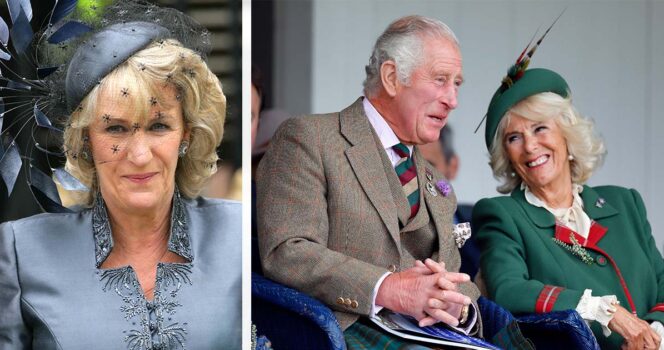
King Charles and Queen Camilla have weathered some of the most difficult periods together. Their complicated journey began with a controversial affair—both were married at the time, Charles to Princess Diana and Camilla to Andrew Parker Bowles. Although Camilla faced intense public backlash and even resistance from within the Royal Family, over time, she managed to shift public opinion and earn a respected place in “The Firm.”
Camilla wasn’t born into royalty. She was raised in Sussex alongside her sister, Annabel, with whom she shared a very close bond. The two attended the same schools and spent most of their early years side by side. Today, Annabel has become a familiar face at royal events, including the coronation of King Charles.
Despite largely staying out of the public spotlight, Annabel recently opened up about Charles and Camilla’s marriage, offering new insight into their relationship. When news of Charles and Camilla’s affair first surfaced, it sparked national outrage, especially given the public’s deep admiration for Princess Diana. While Diana also had extramarital relationships, many viewed Camilla as the villain in the story.
Charles and Camilla’s connection began long before Diana entered the picture. They first met in 1972 at a polo match, introduced by a mutual friend, Lucia Santa Cruz, daughter of the Chilean ambassador. The couple dated briefly, but their romance was cut short when Charles left to serve in the Royal Navy. By the time he returned, Camilla was engaged to Andrew Parker Bowles.
Camilla and Bowles married in 1973, though she remained close to Charles. Eventually, Charles began dating Diana in 1980. When Diana was introduced to the Bowles couple, Camilla found her charming at first. However, tensions soon emerged. Diana would later reveal that Camilla saw her as a threat.
According to Charles’ official biography, his affair with Camilla resumed in 1986, while he was still married to Diana. Diana confronted Camilla after discovering the truth. Though the public didn’t immediately notice any cracks, the royal couple announced their separation in 1992 and finalized their divorce in 1996.
In 1989, a leaked phone call between Charles and Camilla revealed the intimate nature of their relationship, sparking the infamous “Tampongate” scandal. The public was shocked, and polls showed a severe decline in Charles’ reputation. Camilla also faced intense criticism, including from the Royal Family. Queen Elizabeth reportedly avoided interacting with her, and Camilla was frequently mocked and insulted by the public.
Camilla became so unpopular that she rarely left her house, relying on friends to run errands due to fear of public backlash. According to royal biographer Angela Levin, she was often called cruel names like “rottweiler.” Eventually, Charles stepped in, hiring private security for her out of his own pocket until they married in 2005.
Over time, Camilla began to earn public respect. Levin notes that while she’s grown more accepted, she likely still carries emotional scars from those years of hostility. Though some critics remain, Camilla is now seen as a loyal, steady partner.
PR expert Luana Ribeira describes Camilla’s image transformation as a “PR miracle,” especially given her negative public perception in the 1990s. While she may never be fully embraced by the public, Ribeira says Camilla has gained a level of respect for her commitment and resilience. She advises the Queen to continue exactly as she has—steadfast and devoted.
One of Camilla’s greatest sources of support has been her sister, Annabel Elliot. The two have remained close throughout their lives—attending the same schools, marrying in the same year, having children at the same time, and even vacationing together as families.
In the BBC documentary *Charles III: The Coronation Year*, Annabel shared how crucial Camilla has been to King Charles, describing her sister as his “rock”—a calm, steady presence who brings unwavering loyalty and support. In return, Charles has opened Camilla’s world to new experiences and knowledge.
Richard Jackson, Bishop of Hereford, who assisted during the coronation, observed the deep affection between Charles and Camilla, describing the ceremony as a personal family occasion as much as a national event.
Annabel, an accomplished interior designer, also played a significant role during the coronation, serving as a Lady in Attendance. She reflected emotionally on the surreal moment of seeing her sister in the golden carriage, recalling childhood memories of watching Queen Elizabeth’s coronation on a tiny TV.
Though she’s largely stayed behind the scenes, Annabel has long supported her sister’s journey—from scandal and scrutiny to the throne—and continues to stand by her through every royal milestone.