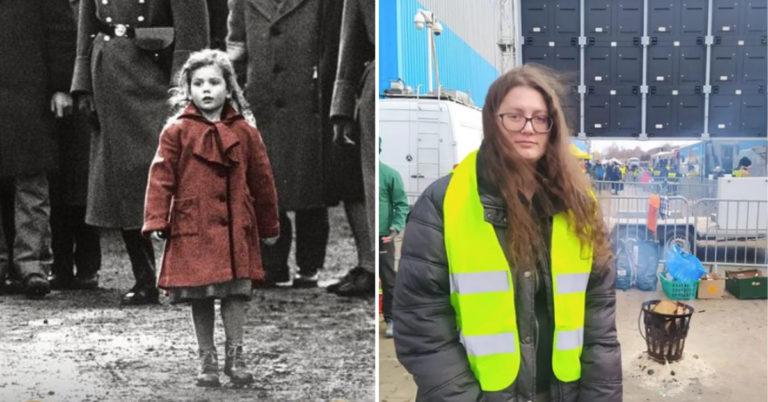
You might not recognize her name, but Oliwia Dabrowska became the focal point of one of the most powerful and emotional moments in Hollywood history when she was just three years old. She played the iconic “red coat girl” in Steven Spielberg’s *Schindler’s List* (1993), a role that remains one of the most memorable scenes in cinema.
The film tells the story of Oskar Schindler (played by Liam Neeson), a German businessman who saves the lives of Polish Jews during the Holocaust. It is widely regarded as one of the most important films about the Holocaust, winning seven Academy Awards, including Best Picture. Its raw portrayal of the horrors of the Holocaust includes numerous haunting moments, but none as famous as the scene where Schindler watches a young girl, in a bright red coat, walking through a Kraków ghetto during a mass liquidation by the SS.
In a film shot almost entirely in black-and-white, the girl’s red coat stands out starkly, focusing the audience’s attention on her, much like Schindler’s. This moment has been interpreted in many ways. For Schindler, the girl symbolizes the innocence of the Jewish people, and her death deeply impacts him, pushing him to save as many lives as possible. To Spielberg, the red coat served as a symbol of the world’s initial indifference to the Holocaust, with the girl’s bright color representing a “red flag” ignored by world leaders, including Roosevelt, Eisenhower, Stalin, and Churchill.
Today, the woman who portrayed that red-coated girl has grown into an adult committed to making a difference. Oliwia Dabrowska, now 32, recently shared an image of her character from *Schindler’s List*, but this time she edited the coat to reflect the yellow and blue colors of the Ukrainian flag. She captioned it: “She was always the symbol of hope. Let her be it again.”
Dabrowska’s actions go beyond symbolism; she has been actively volunteering at the Polish-Ukrainian border, helping refugees fleeing the war in Ukraine. With millions of Ukrainians displaced by the Russian invasion, Dabrowska has worked alongside other volunteers, providing essential supplies and support to those in need. She’s also encouraged her followers to donate, stating, “We need your help here at the Polish-Ukrainian border. Every little bit helps.”
Despite the dangers surrounding her—Russian bombings are just 20 kilometers from Poland—Dabrowska’s commitment to helping those in crisis has only grown stronger. She shared her fear of the proximity of the conflict but expressed that it only fueled her desire to assist refugees even more.
Her work, especially with children, echoes the themes of *Schindler’s List*. Dabrowska was particularly moved by a Ukrainian mother traveling with her two children, desperately trying to reach her sister across the border. “Those kids… my God, I can barely hold back my tears,” she wrote.
Although Dabrowska modestly referred to herself as “just a cog in the machine” among the many volunteers, her actions demonstrate the enduring spirit of *Schindler’s List*. One of the most memorable lines in the film is, “Whoever saves one life saves the world entire.” Dabrowska has certainly embraced that lesson, showing that even small acts of kindness can make a world of difference for those in need.