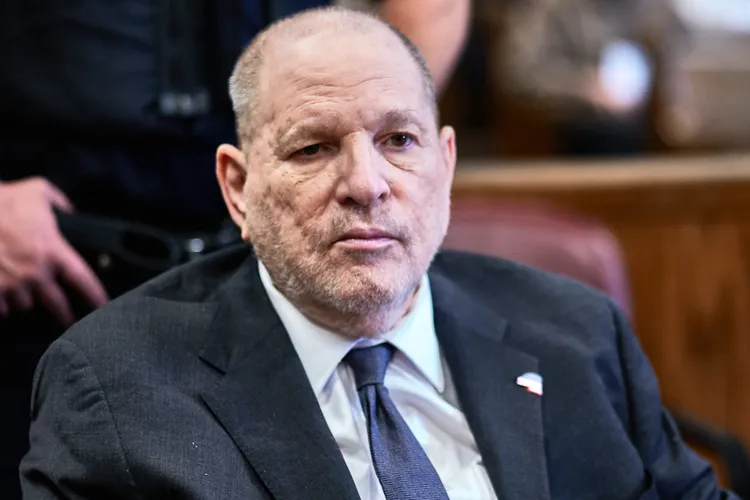
Harvey Weinstein has spoken publicly about his experience at Rikers Island prison.
In his first extensive interview since being moved to the high-security New York facility six years ago, the 73-year-old former film producer told The Hollywood Reporter in comments published on March 10 that life inside the jail has been extremely isolating and miserable.
Weinstein said he rarely interacts with anyone except prison staff.
“I only talk to the guards and the nurses. That’s the extent of my interaction,” he explained. “There’s no socializing in my section. It’s Rikers Island — it’s hell.”
He contrasted his current conditions with his previous time in state prison, saying the experiences are vastly different and that he has repeatedly asked to be transferred back.
“At state prison I had a routine — I woke up, had breakfast, met friends, talked to people,” he said, recalling his time at Wende and Mohawk correctional facilities. “We watched TV together. I’ve been asking to go back to state prison, but the district attorney’s office says that because I have an upcoming trial, I have to stay at Rikers so they can monitor me. They’ve been watching me for 19 months already. I don’t know where they think I’m going.”
In June 2025, Weinstein was found guilty of one count of committing a criminal sexual act related to a 2006 incident involving former TV production assistant Miriam Haley. He attempted to challenge the conviction, citing alleged juror misconduct, but a judge rejected the request during a January 8 court hearing.
In addition, Weinstein was convicted in California in 2022 of raping an actress in a Beverly Hills hotel. That conviction resulted in a 16-year sentence and remains in effect.
As he prepares for a retrial concerning another charge involving aspiring actress Jessica Mann, Weinstein said he has experienced violence while incarcerated at Rikers.
He described one incident that occurred while he was waiting to use a phone.
“I asked the man ahead of me if he had finished,” Weinstein said. “He stepped away and suddenly punched me in the face.”
“I fell to the ground and was bleeding heavily,” he continued. “I was seriously injured. The officers asked who did it, but I couldn’t identify him. You can’t inform on someone — that’s the prison code.”
Weinstein added that because of his notoriety, staying isolated has become the safest option.
“At Rikers, my situation forces me into isolation,” he said. “It’s too risky for me to be around other inmates. They can go outside to the yard, but when I’m there I feel surrounded. People approach me asking for money, legal help, or other things. They constantly threaten and mock me. I wouldn’t survive long out there.”
The legal cases against Weinstein followed investigations published in October 2017 by The New York Times and The New Yorker, which helped ignite the #MeToo and #TimesUp movements addressing sexual harassment and assault across the entertainment industry and other workplaces.
His attorney, Imran H. Ansari, stated in December 2024 that Weinstein has been “completely mistreated” during his imprisonment at Rikers. That same year, Weinstein was also diagnosed with chronic myeloid leukemia.