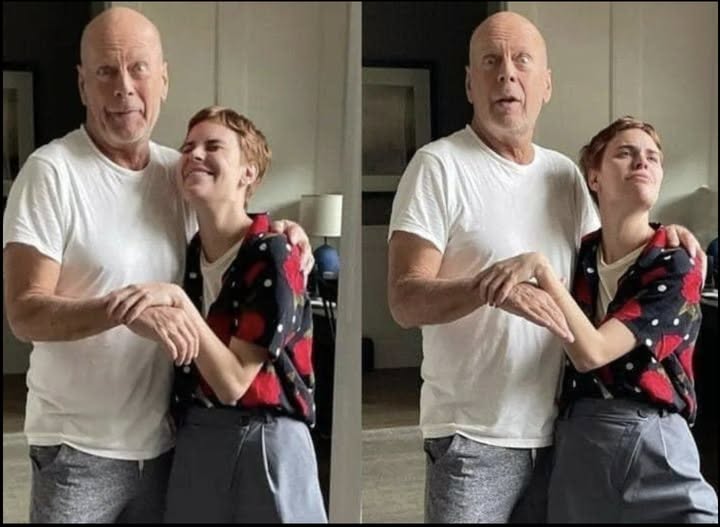
According to his wife, Emma Heming Willis, Bruce Willis is now living in a single-story home apart from his family as part of his ongoing dementia care.
In a new ABC special titled Emma & Bruce Willis: The Unexpected Journey, Emma spoke candidly about what she described as one of the most difficult decisions she has faced since her husband received his heartbreaking diagnosis.
The legendary Die Hard actor was diagnosed with frontotemporal dementia (FTD) in 2023, following an earlier diagnosis of aphasia less than a year before. Since stepping away from public life, updates on Willis’s condition have been rare. In March, a source told In Touch that he rarely expresses hunger, noting that his weight loss and reduced appetite point to a continued decline.
The source explained that the family’s main challenge is ensuring he eats regularly and maintains a diet that supports his health. “It’s a heartbreaking situation that many people caring for loved ones with dementia or Alzheimer’s will recognize,” the insider shared. They added that his awareness is fading, saying, “He can no longer communicate and struggles to recognize people.”
Previously, Emma addressed misinformation circulating online, saying she was “triggered” by claims suggesting that there was “no more joy” in her husband’s life.
In the ABC special, which aired on August 26, Emma revealed to Diane Sawyer that Bruce has been moved into a nearby second home designed specifically to meet his care needs.
“My first thought was always about what Bruce would want for our daughters,” Emma said, referring to Mabel Ray, 13, and Evelyn Penn, 11. “He would want them to grow up in a home centered around their needs, not his.”
She explained that the decision was made some time ago after learning that noise can worsen Bruce’s condition. As a result, their daughters could no longer host friends for playdates or sleepovers. Emma admitted this led to a period of isolation for the family, saying she worried whether other parents would feel comfortable leaving their children there. “That was intentional, but it was incredibly hard,” she said.
Emma described Bruce’s new residence as more of a second family home rather than a place of separation. “We’re there often,” she shared. “The girls have their belongings there too.”
She emphasized that the home is filled with love, care, warmth, and laughter, adding that many of Bruce’s longtime friends continue to visit him. “They bring energy, joy, and life into the space,” she said. “It’s been really beautiful to witness.”
Emma also reflected on the early warning signs of Bruce’s illness, describing them as unsettling. Once outgoing and deeply engaged, he became quieter and more withdrawn during family gatherings.
“He felt distant, almost cold,” she recalled. “That was the opposite of who Bruce has always been—he was warm and incredibly affectionate. That change was frightening.”
Despite his condition, Emma noted that Bruce remains physically active and in generally good health. “His body is strong,” she said. “It’s his brain that’s failing him.”
She added that while his language abilities are disappearing, the family has adapted. “We’ve learned a new way of communicating with him,” Emma explained. “It’s different—but it’s how we stay connected.”