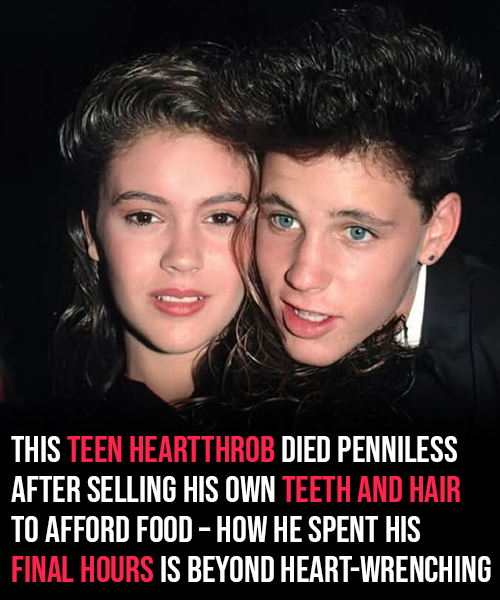
For a brief period in the late 1980s, this Toronto-born performer was one of Hollywood’s most in-demand teen stars. But only a few years later, everything unraveled.
Bankruptcy, addiction, and even being spotted on the streets asking strangers for pizza — the former child actor’s life spiraled into tragedy. When he passed away in 2010, the entertainment world was shocked, and celebrities across Hollywood mourned him.
This is the heartbreaking story of Corey Haim — and how fame ultimately destroyed him.
Growing up in the entertainment industry is challenging, and sadly, Hollywood has seen countless tragic tales. But Corey Haim’s experience remains one of the most devastating. He began as a sweet, gentle boy long before Hollywood took its toll.
Born in December 1971 in Toronto, Haim was naturally shy. To help him gain confidence, his parents enrolled him in acting classes.
By age ten, he was already appearing in commercials, and performing felt effortless to him. Soon after, he landed a role on the TV show The Edison Twins.
When his parents divorced, the shift deeply affected him. Still, his acting career progressed. In 1984, he played Brian Livingston in Firstborn, earning a Young Artist Award nomination and solidifying his place as a rising talent.
Film critic Roger Ebert acclaimed his performance, calling it one of the most complex and compelling portrayals by any young actor of that era. “If he keeps acting at this level, he’ll never fade into obscurity,” Ebert wrote. “He’s that good.”
Everything changed in 1987 when Haim starred in The Lost Boys with Corey Feldman. The two became instant teen icons, leading to more collaborations, including their reality series The Two Coreys.
Fan frenzy
As Haim’s fame soared, fan mail poured in by the thousands from around the world. But the teenage idol wasn’t prepared for the pressure of being adored — or the reckless sense of freedom that came with fame.
In 1988, on his way to the premiere of License to Drive, reporters caught a revealing moment. Speaking to his girlfriend Lala, he said, “We’re going to take a shower together,” then added that she’d get ready afterward.
Turning to his mother, Judy, he casually asked, “We’re calling a limo, right, Mom?”
It became clear that fame had already shaped Corey’s behavior and outlook.
Like many young actors, he didn’t stay in school long. His education stopped after eighth grade. Instead, Haim became a regular at Alphy’s Soda Pop Club, a notorious underage nightclub inside the Hollywood Roosevelt Hotel.
The rise of addiction
According to the Mirror, Haim first experimented with alcohol while filming Lucas in 1986. By the time The Lost Boys was underway, he was smoking marijuana.
After moving to Los Angeles, his drug use escalated dramatically. He began using cocaine, then crack, and entered rehab for the first time at only 18.
But recovery never lasted.
Haim described himself as a “chronic relapser,” and he later became dependent on prescription pills — sometimes taking as many as 85 a day.
Those around him noticed the decline. Dr. Nicki J. Monte, who worked with both Coreys on The Two Coreys, said Haim battled a powerful inner “saboteur” and lived under the grip of addiction that he could never shake.
As his health and dependability worsened, film roles dried up. Haim eventually stepped away from acting for eight years, spending much of his remaining money on medical care.
Desperation and financial collapse
At one point, Haim became so desperate that he attempted to sell his own hair and teeth on eBay.
In 1997, he filed for bankruptcy. His listed assets included a 1987 BMW, $100 in cash, $750 worth of clothing, and around $7,500 in residuals and royalties.
That same period, an E! documentary exposed the grim reality behind his former heartthrob image. The special showed him living with his mother in a bare Santa Monica apartment above a garage. Interviews revealed him to be disoriented, often slurring, and at one point asking for money to buy a slice of pizza — even as he tried to pitch himself to casting agents, insisting he was “the old Corey.”
Haim tried to rebuild his life more than once.
When The Two Coreys was canceled in 2008 due to his addiction troubles, he placed an ad in Variety declaring: “This is not a stunt. I’m back. I’m ready to work. I’m ready to make amends.”
The final years and cause of death
Despite repeated efforts, Haim never conquered his addictions.
He later admitted that he once spent three and a half years without leaving his apartment, during which his weight doubled from 150 to 302 pounds.
On March 10, 2010, Haim died from pneumonia.
Police initially suspected an overdose because his home contained multiple prescription medications, including Valium, Vicodin, Soma, and Haloperidol.
It later emerged that in the month prior to his death, Haim had obtained more than 553 prescription pills using aliases, visiting seven doctors and seven pharmacies.
While the prescription history led to speculation, an autopsy ultimately confirmed his death was from natural causes.
Abuse allegations and lasting controversy
Haim’s story continued to spark conversation long after his death. Years later, Corey Feldman alleged that he and Haim had been abused by men connected to a powerful Hollywood pedophile ring.
Haim’s mother disputed Feldman’s claims overall, though she did confirm that her son had been assaulted once by an adult man.
For the 10th anniversary of Haim’s passing, Feldman released a documentary titled My Truth: The Rape of Two Coreys, exploring the abuse he said they endured as young actors.
One of the most explosive allegations in the film was Feldman’s statement that Haim told him Charlie Sheen assaulted him during the filming of Lucas in 1986, when Haim was 13 and Sheen was 19.
Others interviewed in the documentary — including Feldman’s ex-wife Susannah Sprague — said Haim had confided similar details to them.
Sheen’s publicist rejected the accusations, calling them “sick, twisted and outlandish.” Judy Haim also defended Sheen, urging people to consider the source.
Sheen had previously denied similar allegations reported by the National Enquirer in 2017. He later sued the publication, settling the case in 2018.