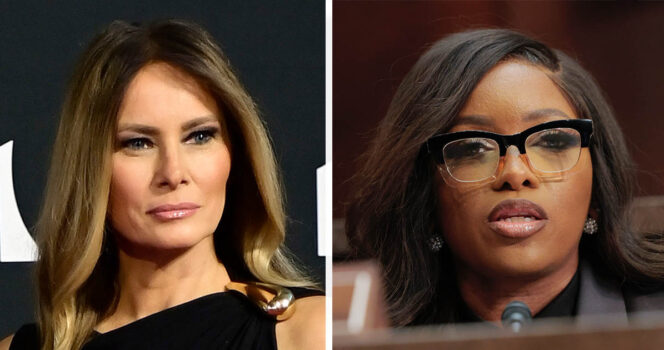
Melania Trump’s journey to the United States began with her aspirations of becoming a model. Like many others, she applied for a visa, which she received in 2001, allowing her to work legally in the U.S. Over the years, she built a successful modeling career and is now serving her second term as First Lady.
However, as the Trump administration pushes to reform immigration laws, Melania’s own visa history has drawn renewed scrutiny. A U.S. congresswoman has now raised concerns about whether Melania was even eligible to enter the country.
From the start of his presidency, Donald Trump made it clear he intended to take a hardline stance on immigration. In his first week back in office, he signed multiple executive orders aimed at curbing illegal immigration. In June, he ordered federal agencies to begin what he described as the largest mass deportation operation in U.S. history—sparking widespread protests. He also imposed strict regulations on visa programs, including one targeting Harvard’s student visa initiative and another banning travel from 19 countries.
As immigration policy dominates headlines, questions about Melania’s own visa have resurfaced. In 2000, she applied for a U.S. work visa with help from model scout Paolo Zampolli, who had previously discovered her and later introduced her to Donald Trump. Before her 2001 EB-1 visa—also known as the “Einstein visa”—Melania had been in the country on tourist and work visas since 1996, according to her attorney.
The EB-1 visa is reserved for individuals with exceptional achievements, such as Nobel laureates, Olympic medalists, or acclaimed professionals in the sciences, arts, or business. In 2001, Melania was one of only five Slovenians to be granted this visa, which has now become a point of contention.
Democratic Representative Jasmine Crockett of Texas raised the issue during a House Judiciary Committee hearing, accusing Republicans of selective outrage when it comes to immigration. She criticized the harsh treatment of some visa holders and questioned how Melania qualified for the prestigious visa.
“It doesn’t take an Einstein to see the math ain’t mathin’ here,” Crockett said, arguing that while Melania had a modeling career, she lacked the elite-level accolades typically required for an EB-1 visa. Crockett went on to contrast Melania’s career with iconic models like Tyra Banks and Naomi Campbell, suggesting the First Lady’s credentials fell short of the visa’s standards.
Melania has not responded publicly to Crockett’s remarks. However, the congresswoman’s comments have sparked backlash online, with some accusing her of being envious or unfairly targeting the First Lady.
This isn’t the first time Melania’s immigration background has drawn criticism. In March, during a protest in Los Angeles, Congresswoman Maxine Waters also questioned her legal status. Waters suggested that if Donald Trump was serious about enforcing immigration laws against undocumented families, he might want to start by examining his own household.
“If Trump wants to undo birthright citizenship, maybe he should first take a closer look at Melania,” Waters said, raising doubts about whether her parents were documented when she came to the U.S.
The debate surrounding Melania Trump’s visa continues to highlight the broader tensions in America’s immigration discourse, especially as her husband continues to push strict policies.