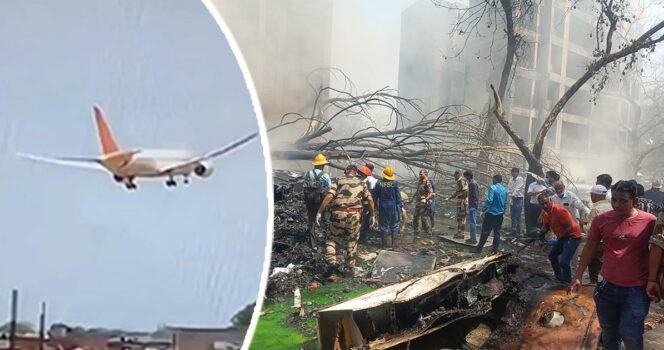
The tragic Air India crash on Thursday has claimed over 260 lives. The exact cause remains unknown, but investigators are on-site, and one of the plane’s black boxes has been recovered. Flight safety experts have already begun sharing alarming theories about what might have led to the disaster.
The world was left in shock when Air India flight A171, en route from Ahmedabad, India, to Gatwick, crashed into a residential area shortly after takeoff from Ahmedabad airport. Of the 242 people onboard, 241 lost their lives, along with several individuals on the ground.
The residential area hit by the crash was home to many medical students, doctors, and their families, according to The Guardian. Just minutes after takeoff, while the Boeing 787-8 Dreamliner was only about 190 meters in the air, the pilots sent a mayday signal to air traffic control. Air India Chairman Natarajan Chandrasekaran, speaking to CNBC-TV18, confirmed that Boeing and GE Aerospace are actively assisting with the investigation, sending their top experts to support the inquiry.
Eyewitnesses described horrifying scenes. Poonam Patni told Agence France-Presse that numerous bodies were found at the scene, many severely burned, as firefighters worked to control the blaze. Another witness recounted seeing residents leap from the second and third floors of nearby buildings to escape the flames, with survivors rushed to the hospital.
Although one of the plane’s black boxes has been recovered, its data has not yet been analyzed. Aviation experts stress the need for patience, warning against premature conclusions before a thorough examination of the black box and flight data recorder is complete.
Still, some specialists have offered early theories. Dr. Sonya Brown, a senior lecturer in aerospace design at the University of New South Wales, suggested that the aircraft may have stalled due to a sudden loss of thrust. She explained that loss of thrust reduces speed, and without enough speed, an aircraft can stall. Footage of the crash showed the plane climbing briefly before losing altitude and vanishing behind trees in flames.
Professor John McDermid, Lloyd’s Register Chair of Safety at the University of York, highlighted that takeoff and landing are the riskiest flight phases, with accidents during cruising being rare. He found it surprising that the aircraft crashed so soon after liftoff and suggested that a sudden, severe issue occurred just after or during the final part of the takeoff roll, leaving the pilots unable to recover. He also dismissed the possibility that excessive weight or fuel load caused the crash.
Prof. Paul Williams from the University of Reading stated that weather conditions were favorable at the time, ruling out turbulence or poor visibility as factors. Prof. Graham Braithwaite of Cranfield University noted that this is the first major accident involving the 787 model and emphasized how critical the takeoff phase is since any malfunctions require immediate pilot action.
Former airline captain Terry Tozer told GB News that it’s far too early to pinpoint the cause. However, he noted that modern aircraft are designed to withstand significant failures during takeoff, making this catastrophic outcome particularly baffling.
The investigation continues as experts work to uncover what caused this devastating crash.