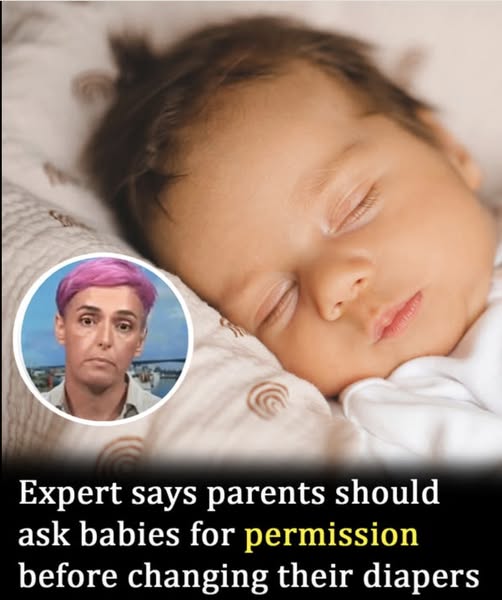
An Australian “sexuality educator” has sparked intense debate online after suggesting that parents should ask their babies for permission before changing their diapers.
Deanne Carson argues that a “culture of consent” should begin at birth — a claim that has left many people baffled, with one commenter jokingly asking whether they should also “get consent from a cat before cleaning its litter box.”
As modern parenting trends shift rapidly, discussions around consent have expanded into unexpected territory, including routine diaper changes.
At first glance, the idea of asking an infant for permission may seem unrealistic, especially since babies cannot speak. But Carson insists her proposal is less about receiving an actual answer and more about laying groundwork for bodily autonomy and respectful interactions.
Carson, who describes herself online as a “sexuality educator, speaker, and author,” says that modeling consent from birth helps teach children early that their bodies deserve respect.
She suggests parents narrate their actions — for example, “I’m going to change your diaper now, okay?” — and then pause briefly to observe the baby’s body language or cues.
Encouraging communication and trust
According to Carson, the goal is not to wait for a verbal “yes,” but to reinforce a respectful exchange between parent and child.
“Obviously a baby won’t respond, ‘yes Mum, please change my nappy,’” she told Australia’s ABC network. “But leaving a moment for eye contact or body language shows the child their response is valued.”
Pediatric specialists often stress the importance of tuning into a baby’s non-verbal signals, such as coos or movements, to support healthy communication. Carson’s approach folds the notion of consent into this practice by helping babies become aware of what is happening to them.
Backlash and criticism
'Sexuality expert' says parents should ask for baby's consent when changing nappies.
Yes, really… pic.twitter.com/iR6wUfP87i
— Sunrise (@sunriseon7) May 10, 2018
Not everyone agrees. Many critics argue that babies are simply too young to comprehend consent at all.
Rowan Dean, editor of The Spectator Australia, dismissed the idea as “lefty lunacy.”
Parenting columnist and psychologist John Rosemond went further, calling Carson’s suggestion “the most bizarre idea of all time.” In the Reno Gazette Journal, he wrote that such advice would once have been viewed as “deranged,” adding that it could lead to confusion and dysfunction in families.
Social media users were even more outspoken, mocking Carson’s approach and questioning her expertise.
One person wrote, “If a baby is crying because their diaper is full… that’s consent. Actually, it’s more like a demand.”
Another commented, “A so-called ‘expert’ who thinks parents need permission to change a diaper clearly has no real experience with kids.”
Others compared it to absurd scenarios, like needing consent from a pet before cleaning up after it, with some calling the idea dangerous or irresponsible since leaving a child in a soiled diaper can be considered neglect.
Voices of support
Despite the backlash, some defended Carson, saying her intent — promoting respect and communication — was worthwhile even if the example was extreme.
One user wrote, “I’m amazed at the negativity. Babies and toddlers communicate long before they talk. Even if she’s wrong, what harm is there in showing respect?”
Another added, “I think she wants to open a discussion about consent for kids, but by applying it to babies she undermined her point. Babies cannot consent — their safety overrides everything.”
A third commenter agreed with Carson’s general message: “Talking to your baby is easy. Creating a home environment focused on consent is too.”
The bigger takeaway
While opinions remain sharply divided, many agree there is value in being attentive and communicative with infants — whether or not it’s framed as “consent.”
Ultimately, whether parents choose to ask for permission comes down to personal parenting style. For some, it’s another way to build a respectful, nurturing bond. For others, simply responding to a baby’s cues and needs is more than enough.